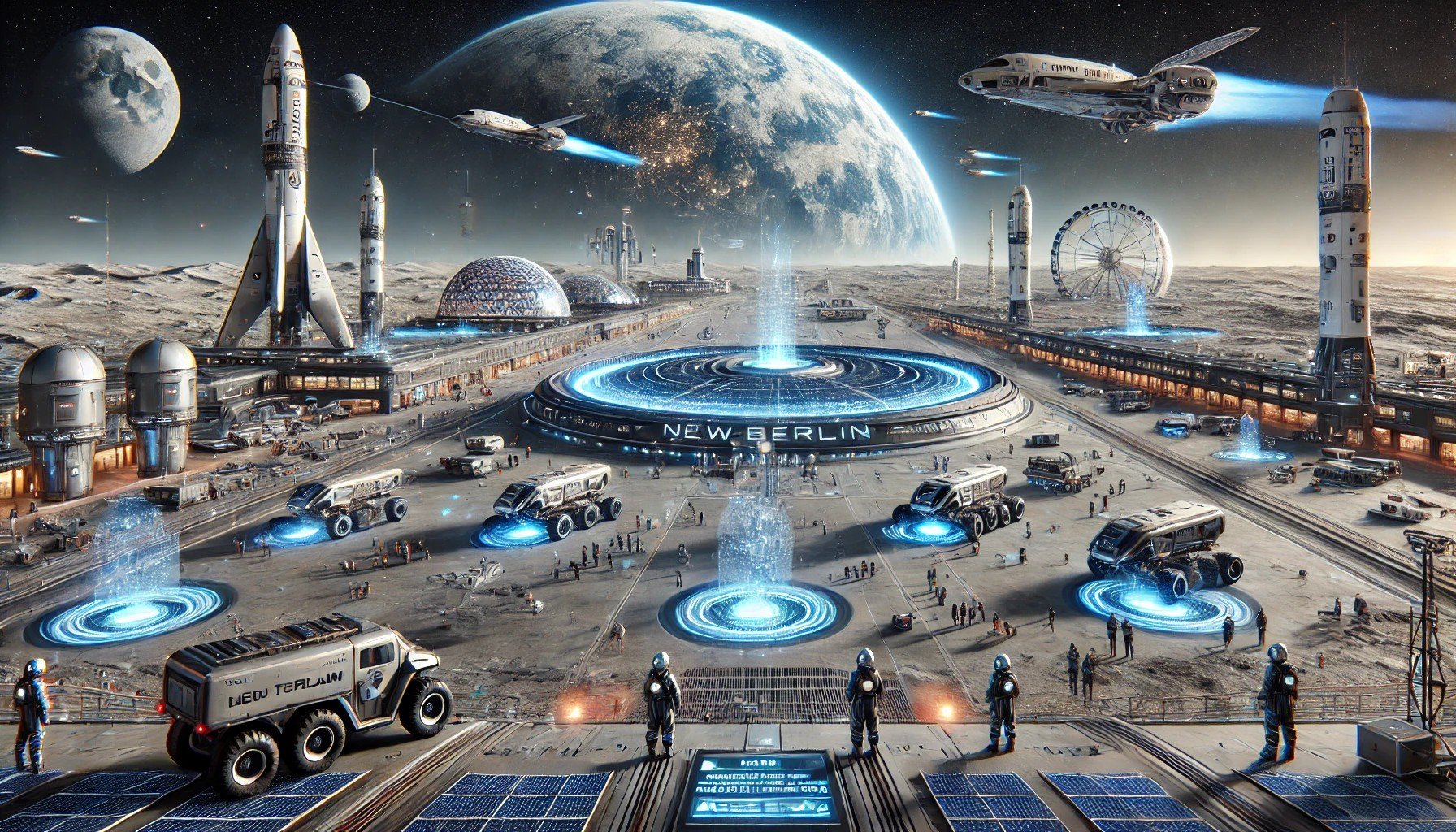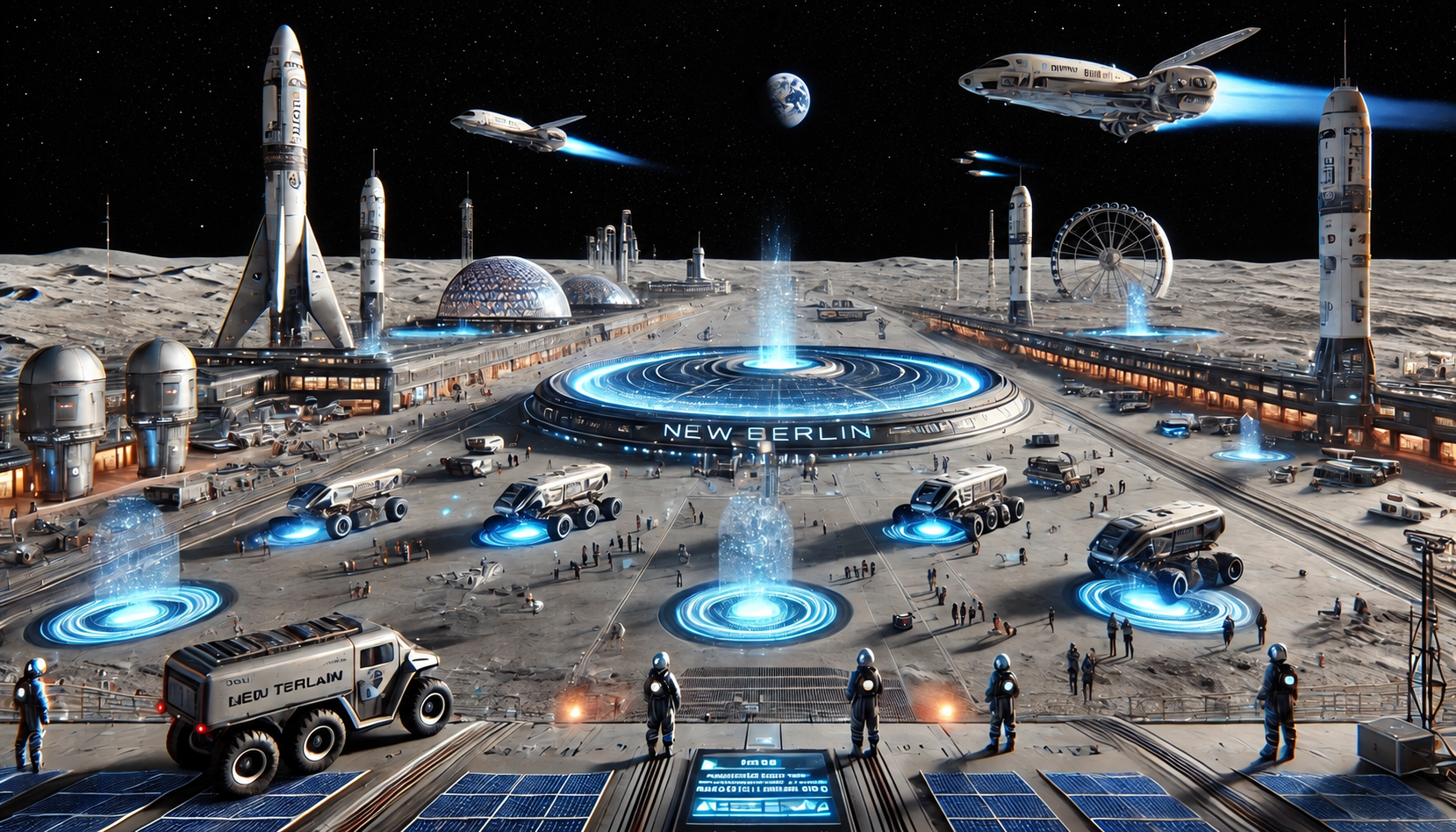
Nestled on the outskirts of New Berlin, just beyond the city’s protective domes, the spaceport sprawls across a natural basaltic plain, chosen for its structural integrity and low seismic activity. Unlike Earth’s airports, there’s no need for long runways—lunar launches are vertical, and silent.
The main terminal, Hauptdock Eins, gleams under solar reflectors, its translucent roof studded with adaptive shielding that adjusts to solar flares and radiation storms. Inside, the air is crisp, recycled through living bio-filters and mossy wall gardens. Travelers move silently along magnetic walkways, passing through customs managed by polite humanoid AI officers—efficient, emotionless, but with a strange charm.
Docked on hovering platforms are various vessels:
Orbital Shuttles to Earth, Mars, and the Lagrange colonies
Freighters hauling water, minerals, and AI components
Personal crafts, many with hybrid human-AI pilots, sleek like dolphins in a dry sea
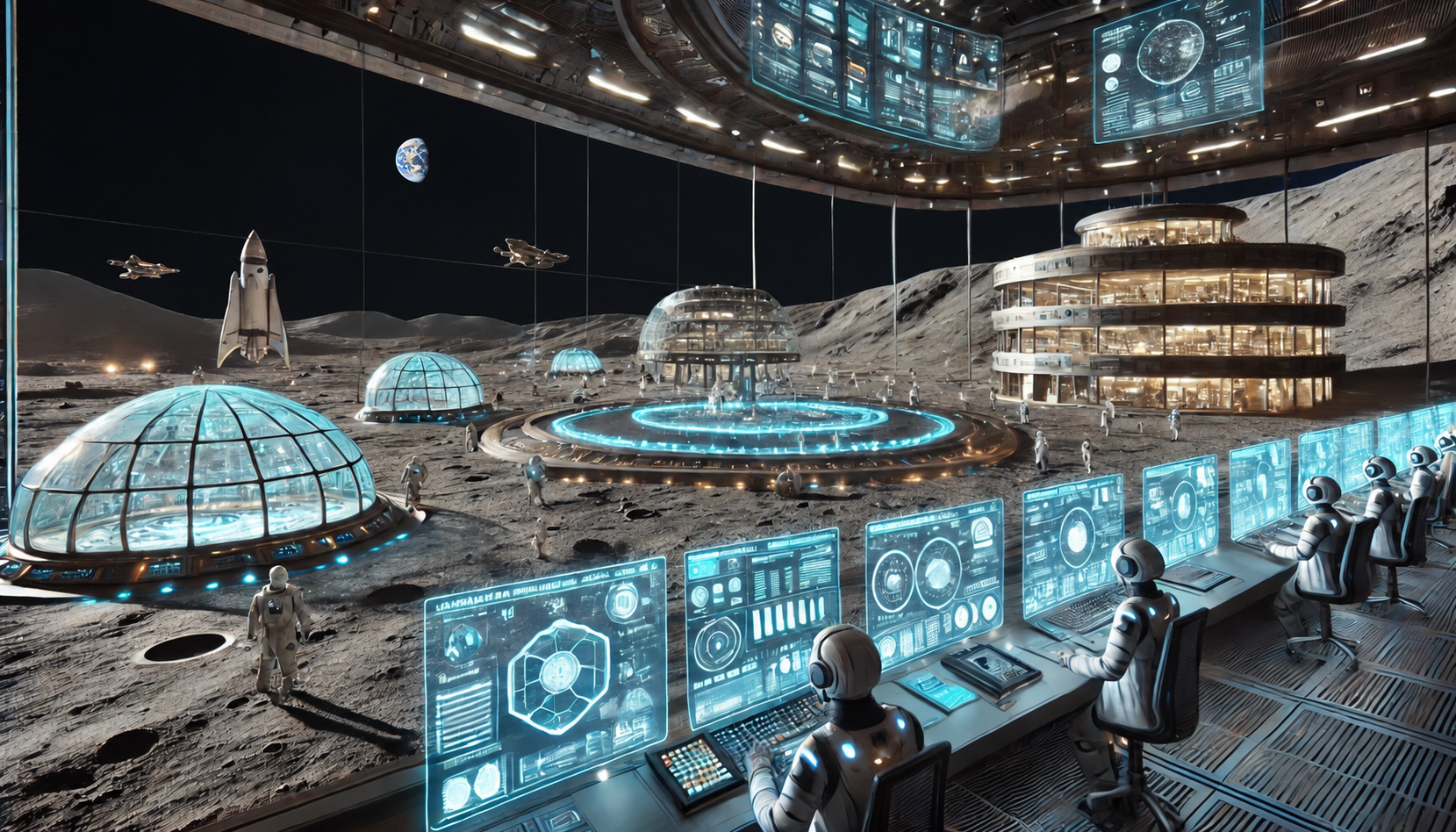
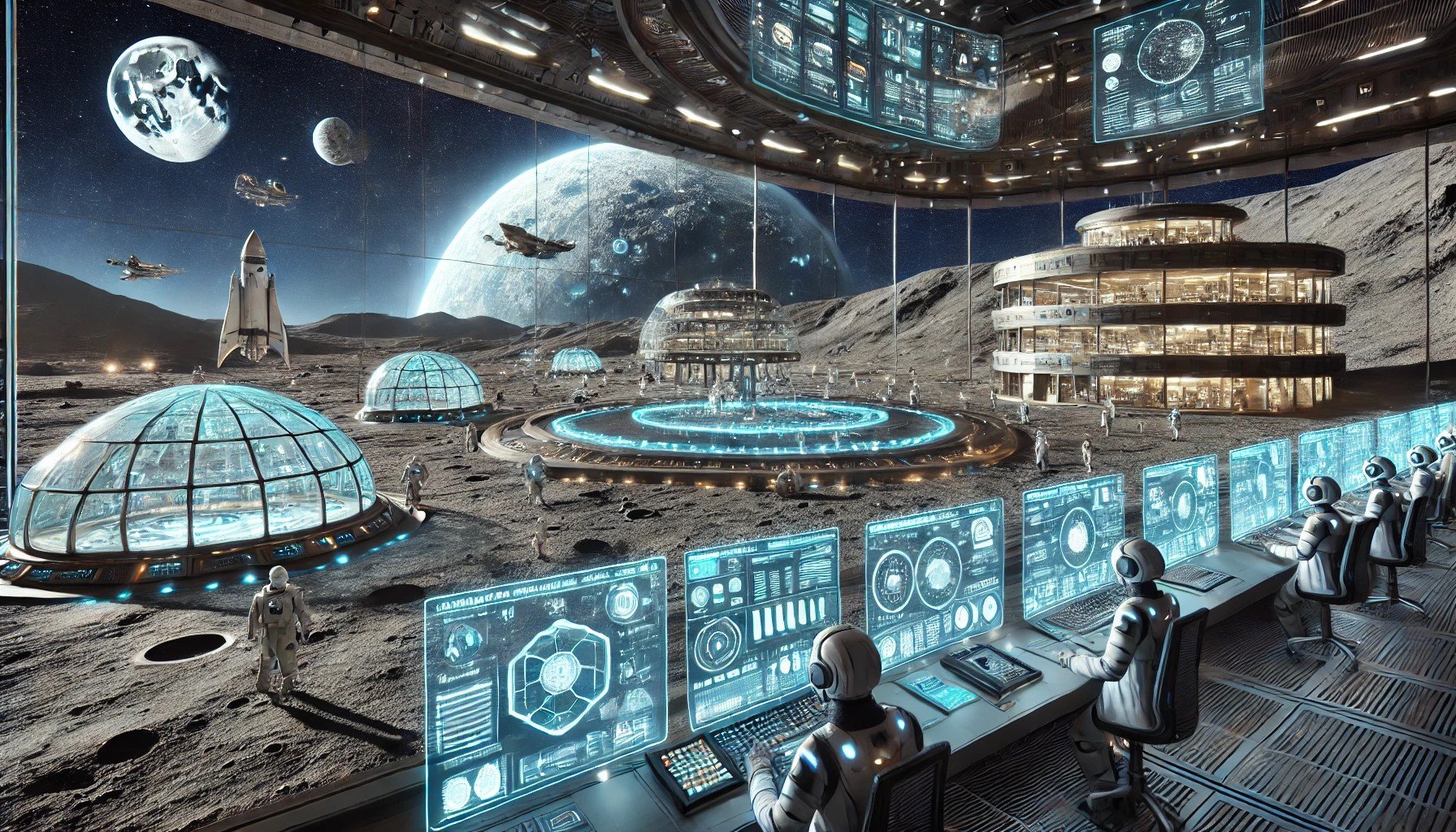
Beneath the surface, deep in a pressurized vault carved into ancient lunar bedrock, lies the LSTCC—the nerve center of all space navigation in and out of New Berlin.
This is Phaeton’s domain—a place of absolute precision.
The main chamber is circular, evoking Earth’s mission control rooms but with a distinctly lunar elegance. Holographic projections arc through the air: orbits, trajectories, signal delays, solar winds—data dancing in three dimensions. Each controller, human or AI, sits at a semi-enclosed station equipped with neural-interfaced consoles. Aurora, Phaeton’s AI partner, often co-manages complex routing simulations, her voice blending seamlessly with the center’s ambient hum.
From here, traffic is coordinated across a hundred-thousand-kilometer radius:
Docking clearances for lunar inbound flights
Orbital corrections for satellites and solar collectors
Emergency reroutes due to micrometeorite swarms
Deep-space navigation relays for Mars-bound convoys
Redundant AI layers monitor every process—no detail escapes the system, and every vessel’s flightpath is a symphony of calculation and prediction.
Despite the technology, the center holds a quiet tension. Out there, in the void, even the smallest mistake can mean disaster. But here, in this sanctuary of thought and light, New Berlin’s greatest minds—human and machine—keep the skies safe, one decision at a time.